Friday, June 20, 2014

Friday the 13th Happy Hour

Some of us had planned to make a beach excursion to view the seemingly giant "Honey Moon" on Friday the 13th...sadly, the fog and rain made this impossible and people had to settle for a mere happy hour at the newly renovated Captain Kidd.  Despite Alberto's severe reservations about the Kidd's new refined aesthetics*, it was a good way to celebrate the start of Woods Hole's scientific season and the intense courses which introduced so many of us to the MBL.


* There's an analogy in here somewhere here about a  pirate reestablishing himself in proper society with the help of stolen booty.  Less salty but more sophisticated--sacrificing adventure for respectability, pizza for lobster bisque, mayo for garlic aioli, etc.

National Xenopus Resource tour

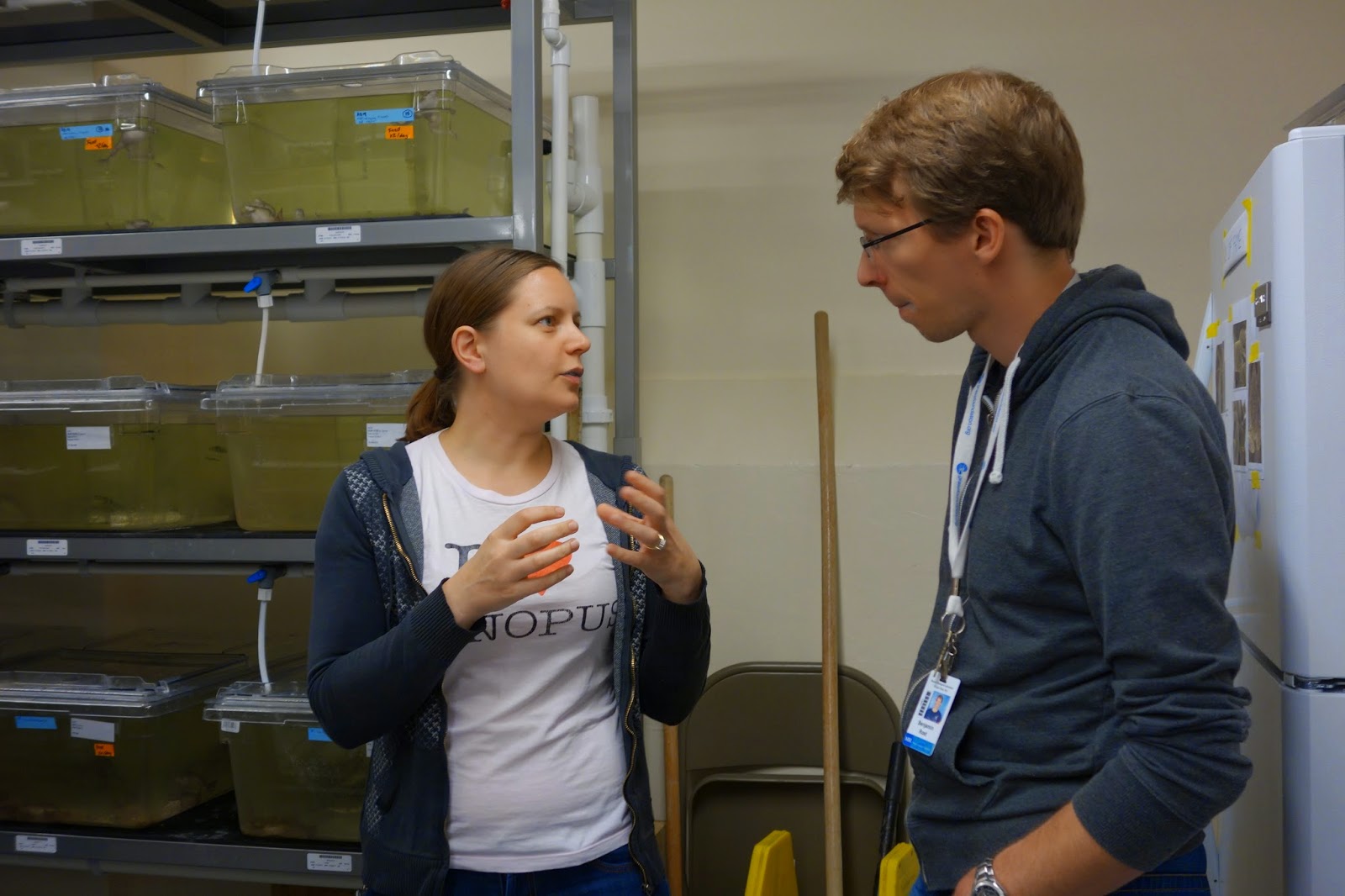
Reyna is working in Xenopus, studying retinal degeneration and regeneration.  She kindly arranged arranged a tour of the National Xenopus Resource center here at the MBL to show us where she works and how the center is run.

The venerable African amphibian has made many scientific contributions, particularly to developmental biology...and it also produces eggs on (hormonal) command.  


The NXR keeps many lines of frogs at different life stages and also provides training in advanced experimental techniques.


Esther Pearl from the Horb lab gave the tour and explained the life cycle and maintenance of the frogs.


Not as racy as it may appear.


One of countless staring contests


Frog optical illusion

Thursday, June 12, 2014

Bliss for Chris !!!

Chris is investigating how signals from the motor cortex and the cerebellum -- two important areas of the brain's motor processing circuitry-- are integrated in the thalamus. He is doing this with a combination of the latest available tools, which is very promising and very challenging. Nonetheless, he succeeded to record the first spikes in a running mouse in the Grass lab 2014. But this was already one week ago and in the meantime Chris managed to repeat this recording but this time from single neurons. Given that he even went whole-cell we are curious what will happen next. 


Spikes from a single neuron

Wednesday, June 11, 2014

Monday, June 9, 2014

Wine and astronomy with Rodolfo Llinas

On Saturday evening we  had clear skies, so Rodolfo Llinas very kindly invited us to his house to drink wine (out of Lord of the Rings pewter goblets!) and look through his telescope.  Look up through a telescope vs. down through a microscope stimulated some interesting discussions which will likely be revisited throughout the summer.

We (Yuyu, Alberto, Chris, Rebecca, Tim, Alex behind camera) arrived a bit early so the sun was still setting. Apparently to the chagrin of the neighbors, the rotating observatory for the telescope can be seen on the top of the house. 


Spectacular sunset over Buzzard's Bay, seen out of the observatory's sliding door


The interior was lit exclusively with red lights so that our vision remained dark-adapted


Mobile phone picture of the moon's surface


Professor Llinas himself at one part of the "rig"


Minor acquisition software grief...this time with the single photon camera


At 23 million light years away, the Whirlpool Galaxy prompted some existential vertigo


Thursday, June 5, 2014

TIM FOR THE WIN!!!

Tim's doing ephys work looking at the effects of perineuronal nets on the remarkably fast spiking properties of auditory brainstem neurons.  Action shots from the lab below:

Making mouse brain slices just a few hundred microns thick allows visually targeted recordings. The machine is like a tiny deli meat slicer with a vibrating blade; the brain is chilled first to minimize cell death.


Brain slices rest comfortably in oxygenated artificial cerebrospinal fluid to allow neurons to recover and damaged tissue to slough off for better recordings.


Slice in place, ready for recording using a patch clamp electrode.  To keep the slice alive, the ACSF bath is constantly circulated and reoxygenated. 


Tim and Yeowool plus rig


Something can be seen...perhaps cerebellum?


After the traditional inaugural wrestling with the acquisition software, a first patch, break in, and whole cell recording!  Where ever the neuron may be, it appears to have at least passive membrane properties.  And perhaps receives inhibitory input?


BUT WAIT!!! Via the magic of sodium channel deinactivation and post inhibitory rebound, we see a regenerative depolarization of some kind!  It's official...Tim has recorded the first action potential of the summer.  


Sadly, we had not firmly established a prize for first recording, so eternal fame via this widely read blog will have to suffice as a reward.